The Thing Beneath the Thing
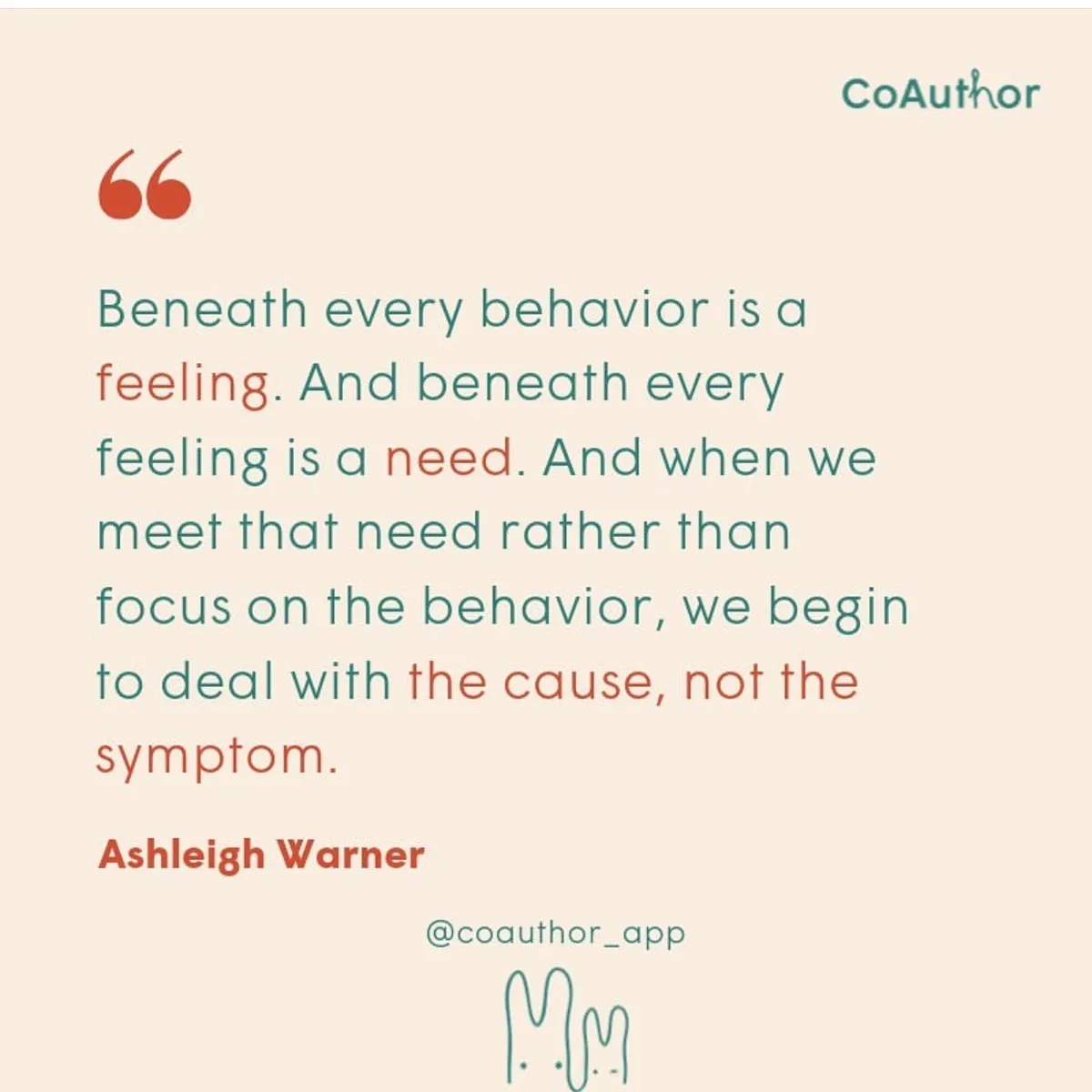
There’s a quote I ran across recently that stopped me in the middle of scrolling; which, if I’m being honest, is AuDHD rare. Most internet wisdom arrives packaged in the kind of simplicity that makes it immediately shareable and immediately forgettable.
This one lingered.
Beneath every behavior is a feeling. Beneath every feeling is a need.
On the surface, it reads like one of those tidy psychological formulas that fits neatly into a square image with calming colors. The sort of thing you nod at, maybe send to a friend, and then move on from without thinking too deeply.
But the more I sat with it, the more I realized how uncomfortable that idea actually is.
Because if it’s true—even partially true—it means that most of the things we react to in relationships are only the visible layer of something much deeper.
And visible layers are deceptive.
Take something simple: someone being short with you in a conversation.
The behavior is easy to identify.
A clipped response. A dismissive tone. A change in posture.
Behavior invites reaction. Our brains are built to respond to it quickly.
Why are they being rude?
But if the quote is right, behavior isn’t the origin point. It’s the surface ripple.
Underneath that ripple is a feeling.
Maybe frustration.
Maybe exhaustion.
Maybe resentment that’s been quietly accumulating somewhere outside the moment you’re witnessing.
And underneath that feeling is a need.
The need might be something as ordinary as rest. Or recognition. Or attention. Or reassurance.
The problem is that we rarely see the need clearly enough to respond to it.
Most of the time we just respond to the ripple.
For someone like me, that’s where things get complicated.
When you spend a large portion of your life trying to understand systems — emotional systems, conversational systems, relationship systems — you start noticing those layers whether you want to or not.
Behavior.
Feeling.
Need.
It becomes almost automatic to ask:
What’s actually happening here?
Sometimes that instinct is helpful.
If someone is frustrated because they feel unheard, listening solves the problem more effectively than arguing about tone.
If someone is distant because they feel overwhelmed, space might be the real solution rather than confrontation.
Seeing beneath the behavior can turn conflicts into puzzles instead of battles.
But there’s a catch.
Actually meeting the need beneath the feeling requires two people who are willing to acknowledge that need.
And that’s where the neat formula starts to unravel.
Needs are uncomfortable things to name.
Especially adult ones.
It’s much easier to say:
“I’m annoyed.”
Than to say:
“I feel unimportant.”
It’s much easier to criticize someone’s behavior than to admit you wanted something from them that you didn’t receive.
So instead of naming needs directly, we often communicate them sideways.
Sarcasm.
Withdrawal.
Jokes.
Raised voices.
Or silence.
Behavior becomes the language we use when we don’t know how to say what we actually need.
Looking back at some of the most confusing moments in my past relationships, I can see now how often everyone involved was responding to the wrong layer of the equation.
Someone would react to behavior.
Someone else would defend the behavior.
The conversation would spiral around that surface level while the underlying feeling—and the need beneath it—remained unspoken.
It’s like arguing about waves while ignoring the tide.
And when that happens long enough, the original need doesn’t disappear.
It just finds new behaviors to express itself through.
There’s another complication.
Sometimes the need beneath a behavior isn’t something another person can actually provide.
A person might need validation that only they can cultivate internally.
Or reassurance that cannot be sustainably outsourced.
Or a sense of identity that no relationship can supply.
When that happens, people sometimes keep searching for the solution in other people anyway.
Because it feels easier to fix a relationship than to examine the deeper question underneath it.
I don’t say any of this from a place of certainty.
If anything, this quote has made me realize how often I misunderstood the systems I was trying to analyze.
I thought if I could explain behavior clearly enough, the problem would resolve.
But explanation works best at the level of behavior.
Needs live somewhere deeper.
And deep things are harder to translate.
Sometimes people don’t even know what they need until long after they’ve acted on it.
Sometimes they discover it only after the behavior has already changed the system around them.
There’s also a quiet irony in all of this.
Because the instinct to analyze layers — behavior, feeling, need — can sometimes create the illusion that understanding the structure is the same thing as solving it.
It isn’t.
Understanding a pattern doesn’t guarantee that the people inside the pattern want the same outcome.
Sometimes two people can look at the same system and see entirely different problems.
Or no problem at all.
So I’ve been sitting with that quote today. Beneath every behavior is a feeling. Beneath every feeling is a need. I suspect it’s both true and incomplete. Because relationships introduce another layer that the quote doesn’t mention. Beneath every need is a question: Is this something we can meet together? Or is it something that was never really ours to solve in the first place?
And the difficult thing about that question is that the answer often arrives long after the behavior that prompted it.
Which means sometimes the only thing you can do is recognize the pattern… and learn from it the next time the tide starts to move.